
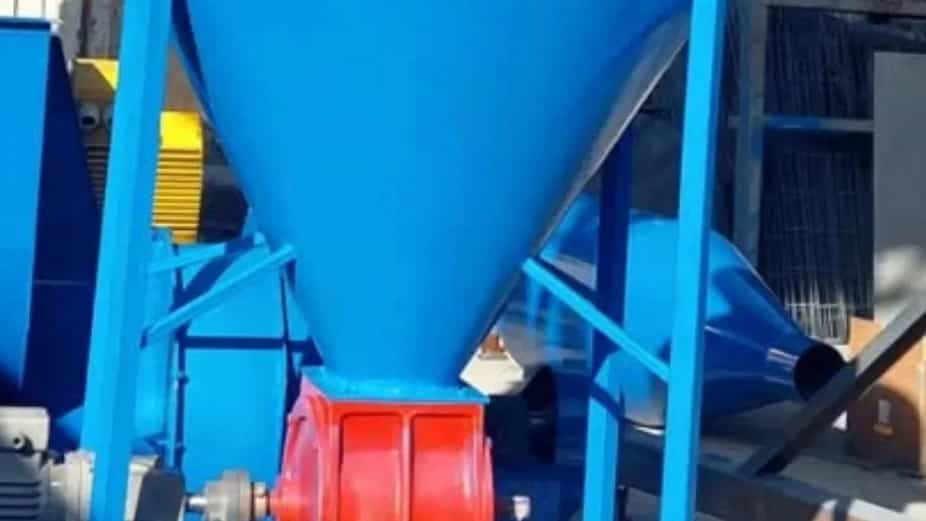
In heavy industries, dust control is not only an environmental issue, but directly related to production quality, human health, equipment life and production line stability. For this reason, Isfahan industrial dust collector has become one of the main control equipment in steel and cement factories. Wherever powder materials are transported, crushed, milled, loaded, unloaded and filtered, the possibility of releasing suspended particles increases and if these particles are not contained, they cause serious technical and economic damages.
In Isfahan, due to the high concentration of mother industries, the need for Isfahan industrial dust collector is felt more than many other cities. Steel plants, cement plants, mines, material transfer lines, and processing plants all face high volumes of particulate pollution that must be collected before entering the environment. In this situation, using a process-engineered system is not only a good choice, but part of the requirements of professional operation.
Importance of Isfahan industrial dust collector in steel industry
Steel industry deals with high temperature, abrasive particles, metal dust and large volume of raw materials and finished product. In this industry, Isfahan Industrial Dust Collector plays an important role in controlling pollution caused by smelting units, casting, raw material transfer, crushing, conveyors and silos. If the dust is not collected properly, both the quality of the work environment will decrease and the depreciation of the equipment will increase.
In steel units, dust is often abrasive in nature and can damage fans, ducts, filters, and electrical components. Therefore, the design of Isfahan industrial dust collector for this industry should be done according to working temperature, type of particles, air flow rate, static pressure and operating conditions. Otherwise, the system will face efficiency loss, frequent clogging and high maintenance cost.
The role of Isfahan industrial dust collector in the cement industry
In cement factories, dust production is present in almost all stages of the process. From crushing and grinding to mixing, conveying, packaging and loading, fine particles of cement and raw materials are dispersed in the air everywhere. In such a situation, Isfahan industrial dust collector helps to maintain the cleanliness of the environment, control pollution and increase the efficiency of the lines.
The important feature of dust in the cement industry is its fineness and high diffusion capability. For this reason, the design of the system must be such that it can collect very fine particles with high efficiency. If Isfahan industrial dust collector is chosen correctly, waste of materials, deposits on equipment, pollution of the environment and reduction of product quality will be avoided. This issue is especially important in packaging and material transfer units.
Main components of Isfahan industrial dust collector
A standard Isfahan industrial dust collector system usually consists of several key parts. Each of these parts has a role in the final performance of the system, and the weakness in each part affects the whole set.
Filters are the main part of collecting particles and depending on the type of application, they can be chosen from different materials. The body of the device must have sufficient resistance to pressure, vibration and environmental conditions. The suction fan is responsible for creating air flow and should be selected according to the pressure drop of the system. Also, the collection hopper or funnel, dust evacuation system, chassis, inspection valve and in some models the filter cleaning system can also be seen in the structure of Isfahan industrial dust collector.
The correct design of these components makes the device perform stably in the long term and reduces the need for frequent stops for service.
Types of Isfahan industrial dust collector for different applications
Depending on the type of industry and the amount of pollution, several different models are used for Isfahan industrial dust collector. In the steel and cement industries, bag systems, cartridges and some cyclone models are mostly used in the pre-separation stages.
Bag dust collector is very suitable for high volumes of air and various particles and is used in many industrial lines. The cartridge dust collector is mostly used for spaces with fine particles and the need for precise filtration. Cyclones are also usually used as primary separators to reduce the particle load at the entrance of the main system.
Choosing between these models should be done based on the required air flow rate, type of particles, process temperature and humidity level. For example, in steel, thermal resistance and mechanical strength may be more important, while in cement, fine particle collection efficiency and ease of dust evacuation take priority. For this reason, no Isfahan industrial vacuum cleaner should be chosen solely based on price.
Isfahan industrial dust collector selection criteria
If the goal is to buy an efficient and durable Isfahan industrial dust collector, several technical criteria should be taken seriously. The first criterion is to know the exact source of dust production. Without knowing the type of particles, temperature, air volume and working conditions, it is not possible to make the right choice.
The second criterion is the capacity of the device. If the capacity is lower than the actual requirement, the system will not work properly, and if it is chosen too large, the initial cost and energy consumption will increase. The third criterion is the material of the filter and body. In abrasive or hot environments, the use of inappropriate materials will reduce the useful life of the device.
The fourth criterion is the possibility of service and maintenance. Esfahan industrial dust collector should be designed in such a way that filter replacement, dust discharge and periodic inspection can be done with the least amount of downtime. The fifth criterion is compatibility with the installation space. In many industrial units, there is space limitation and the design must be compatible with the existing layout.
Advantages of using Isfahan industrial dust collector
Using Isfahan industrial dust collector has many advantages for factories and industrial workshops. The most important advantage is the reduction of air pollution in the work environment, which helps the health of the personnel. The next advantage is preventing dust deposition on the equipment and thus reducing wear and tear.
On the other hand, collecting suspended particles helps to improve the order of the production environment and reduce stoppages caused by cleaning. In many units, the use of a suitable Isfahan industrial dust collector system increases the efficiency of the line and reduces the waste of raw materials. Also, complying with environmental requirements and reducing regulatory complaints and warnings are other direct results of this equipment.
Why is special design important for Isfahan industrial dust collector?
In industrial projects, the general version usually does not give an exact answer. Each steel or cement factory has its own conditions; From the type of materials to the height of the hall, transmission routes, ambient temperature, humidity and operation pattern. For this reason, special design for Isfahan industrial dust collector is very important.
Special design means that the device is made or selected based on the actual needs of the production unit. This will increase system efficiency and reduce maintenance costs. Also, in the exclusive design, you can go for better positioning, accurate capacity measurement, choosing the right filter and predicting the service routes. The result of this approach is an Isfahan industrial dust collector that is really compatible with your process, not just a ready-made and general equipment.
The dynamic role of industry in supplying Isfahan industrial dust collector
In industrial projects, cooperation with a group that has both technical knowledge and executive experience is decisive. Poya Sanat, with its engineering approach and focus on designing and supplying industrial equipment, can play an effective role in the selection and implementation of Isfahan Industrial Dust Collector.
If your goal is to set up or optimize a dust control system in a steel or cement plant, working with a group like Poya Sanat will help you have a more accurate path from the needs assessment stage to equipment selection and final implementation. To learn more about this collection and view related information, you can visit bagfiltersanati.ir.
Maintenance and service of Isfahan industrial dust collector
Even the best Isfahan industrial dust collector does not maintain its optimal efficiency without basic maintenance. Periodic service of filters, fan inspection, channel leakage control, hopper inspection and ensuring the correct operation of the drainage system are essential maintenance tasks.
If the filters are not cleaned or replaced on time, the pressure drop will increase and the energy consumption will increase. Also, if the service is neglected, particles will pass through the system and the actual effect of the dust collector will be reduced. Therefore, for every Esfahan industrial dust collector, a regular maintenance program should be defined so that the device maintains the same initial efficiency over time.
Final summary
For steel and cement industries, Isfahan industrial dust collector is not an accessory, but a part of the main production infrastructure. Choosing the right system can play a decisive role in reducing pollution, increasing the life of equipment, improving the quality of the work environment, and maintaining productivity.
If you are looking for a precise, practical and suitable solution for your industrial conditions, technical review and expert advice before purchase is very important. be.
To start making a right choice, prepare your process specifications today, measure the line needs and take action to get the right solution in the field of Isfahan industrial dust collector. Every day of delay in dust control means more cost, higher depreciation and less productivity.